Hoojuy Display Typeface for Handmade & Boutique Brands
As a maker who designs printable invitations, hand-stamped tags, and SVG cut files for mugs and tote bags, I’ve learned that the right display font does more than look pretty—it builds trust, signals quality, and makes customers pause mid-scroll. Hoojuy is one of those rare display typefaces that feels both timeless and quietly confident—like a well-tailored blazer or a vintage apothecary label you’d want to keep forever.
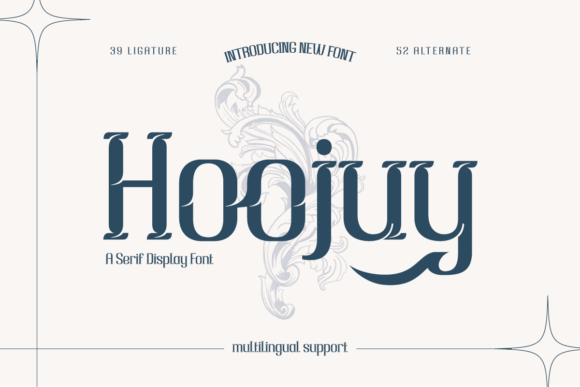
Hoojuy belongs to the classic display category: refined but never stiff, elegant but never fussy. Its letterforms balance subtle serif details with clean, open spacing—giving it strong legibility at small sizes while still commanding attention at large ones. It’s not a script, not a sans serif, and not overly decorative—but it carries the warmth and intentionality of retro modernism. Think 1950s book covers, boutique packaging from the early 2000s, or artisanal coffee shop signage—all with quiet sophistication.
I reach for Hoojuy when I need a font that says “I care about craft” without saying a word. For handmade candle labels, its balanced weight and crisp terminals hold up beautifully on matte kraft paper—even at 10pt on a 1.5" tag. On vinyl stickers for planners or water bottles, it cuts cleanly in Cricut Design Space and Silhouette Studio because the counters stay open and stroke contrast stays moderate (no ultra-thin hairlines that vanish in print or cut). And unlike some high-contrast display fonts, Hoojuy remains readable in mockups viewed on mobile—critical when your Etsy listing lives or dies by that first thumbnail.
Here’s where Hoojuy shines in real product work:
- Wedding stationery: Use it for “Mr. & Mrs.” on foil-stamped welcome signs or as the main name font on save-the-dates—it reads clearly at arm’s length and photographs beautifully.
- Boutique product tags: Pair it with a soft handwritten font for “Hand-poured • Small Batch • Made in Portland”—Hoojuy anchors the message; the script adds personality.
- Digital printables: Planner headers, wall art quotes (“Gather • Grow • Glow”), and habit trackers gain instant polish with Hoojuy’s structured rhythm.
- Seasonal packaging: Holiday cookie boxes, spring herb sachets, or autumn soap bundles all benefit from Hoojuy’s understated charm—it feels intentional, not trendy.
- SVG designs for apparel: It scales cleanly from tiny chest logos on tees to bold front prints on canvas totes, especially when exported as vector outlines.
Readability matters most where function meets finish. Hoojuy works best for short, impactful text: names, titles, product lines, slogans, and headings. It’s not built for body copy—but that’s exactly why it excels as a display font. I avoid using it for full invitation paragraphs or multi-line ingredient lists. Instead, I use it for the headline (“Elena & James • October 12, 2024”), the venue name on a wedding sign, or the flavor name on a bath bomb label (“Lavender & Oat Milk”). That focused use keeps your design hierarchy clear and your customer’s eye moving where you want it to go.
Font pairing is where Hoojuy truly becomes versatile. Try it with:
- A relaxed, slightly irregular script font for names or callouts—think delicate flourishes next to Hoojuy’s steady structure.
- A warm, humanist sans serif (like Montserrat or Quicksand) for supporting text—perfect for ingredient lists, care instructions, or event timelines.
- A low-contrast serif like Merriweather or Lora for longer descriptive text in digital templates—creating contrast without visual competition.
Before downloading, check what’s included: Hoojuy typically comes in OTF and TTF formats, with standard OpenType features like ligatures and stylistic alternates. If you’re designing for international markets or bilingual clients, verify multilingual support—some versions include extended Latin characters, which helps with accented names on wedding invites or French/ Spanish product descriptions.
Licensing is non-negotiable—and often overlooked. Hoojuy is a commercial font, meaning you’re fully covered to use it in physical products (stickers, mugs, tags), digital downloads (PDF planners, Canva templates), SVG files for cutting machines, and client projects—as long as your license permits commercial use. Always double-check the vendor’s terms: some licenses restrict resale of unmodified font files or require extended licensing for merchandise with mass distribution. When in doubt, treat Hoojuy like any other design asset—you own usage rights, not ownership of the font itself.
What sets Hoojuy apart isn’t just how it looks—it’s how it behaves across materials and contexts. It holds up on textured paper, renders crisply in PNG mockups, aligns evenly in layered SVG files, and avoids the “too trendy” trap that dates designs within a season. It supports your brand voice instead of shouting over it.
If you’ve ever hesitated to use a display font because it felt too fragile, too ornate, or too hard to pair—I encourage you to test Hoojuy with a simple project this week: a set of three printable gift tags, a digital wall quote, or a single product label. See how its clarity and character elevate something ordinary into something that feels thoughtfully made. That’s the quiet power of a well-chosen display typeface—and why Hoojuy has earned a permanent spot in my font library.